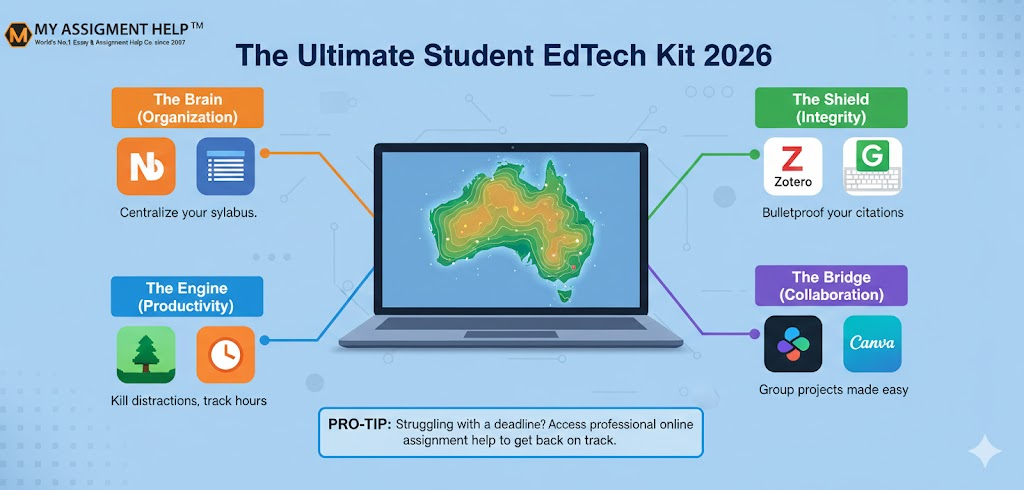
In the ever-evolving landscape of Australian higher education, the “classroom” is no longer just a sandstone building in Sydney or a modern lecture theatre in Melbourne. As of 2026, the shift toward hybrid and remote-first learning has become the standard. With institutions like Adelaide University phasing out traditional face-to-face lectures in favor of digital-first activities, the burden of organization has shifted from the faculty to the student’s desktop.
For the modern Aussie student, the challenge isn’t just about what to study, but how to manage a digital ecosystem that never sleeps. From the Great Barrier Reef to the outskirts of Perth, students are leveraging a new suite of digital tools to bridge the gap between isolation and academic excellence.
However, even with the best apps, the pressure of simultaneous deadlines can be overwhelming. Many students find that seeking online assignment help is a strategic way to manage their workload, allowing them to focus on deep learning while professional mentors assist with complex structuring and research.
In a remote-first world, a paper diary simply doesn’t cut it. Modern Australian students are turning to Notion and Trello to build “Second Brains.”
Data Insight: Recent 2025-2026 education surveys indicate that 91% of Australian university students now rely on laptops as their primary study tool, with over 40% of graduate students enrolled in fully online programs.
Living in a remote-first world means your study space is also your gaming or relaxation space. The lines are blurred. To combat “digital fatigue,” two tools stand out:
Sometimes, despite perfect time management, life happens—part-time jobs, family commitments, or health issues. In such emergencies, the option to pay someone to do assignment tasks can act as a critical safety net. This allows students to maintain their GPA without sacrificing their mental health during peak exam seasons.
Remote-first doesn’t mean “solo.” Group projects are still a staple of the Australian curriculum.
With the rise of AI, Australian universities (regulated by TEQSA) have become more stringent about academic integrity.
A1: Yes, it is legal to use these services as study guides, model papers, or for research assistance. However, submitting someone else’s work as your own violates university academic integrity policies.
A2: For communication, Slack or Discord is best. For collaborative document creation, Google Workspace or Canva (for visual projects) remains the gold standard.
A3: Implement the Pomodoro technique using apps like Forest and ensure you have a dedicated physical “study zone” that is separate from where you sleep.
Jane Henderson is a Senior Academic Consultant at MyAssignmentHelp. With over a decade of experience in the Australian higher education sector, Jane specializes in helping students transition from traditional learning environments to the digital-first era. She is a passionate advocate for digital literacy and mental wellbeing in the student community.
